 Smart Charger Safety Socket, Intelligent Charging Safety Outlet, Smart USB Charging Socket, Overload Protection Smart Plug, IoT Smart Charger Outlet
Customer Service Hotline:
+8613261677119
Smart Charger Safety Socket, Intelligent Charging Safety Outlet, Smart USB Charging Socket, Overload Protection Smart Plug, IoT Smart Charger Outlet+8613261677119
Liquid level measurement is one of the most fundamental and critical parameters in industrial process control and environmental monitoring. From ensuring adequate municipal water supply to preventing chemical tank overflows, from monitoring flood-prone rivers to managing oil storage terminals — accurate, reliable level measurement directly impacts operational safety, regulatory compliance, and resource efficiency. Wireless IoT level sensors eliminate the costly and complex cabling of traditional wired instruments, enabling wide-area deployment at a fraction of the infrastructure cost.
Wanlin Fire Control is committed to advancing wireless level measurement technology. Our Low Power Level Monitor incorporates the latest innovations in sensor technology, wireless communication, and cloud-based data analytics — including multi-protocol cellular connectivity (4G/NB-IoT), advanced signal processing algorithms, and an intuitive cloud platform that transforms raw level data into actionable operational insights for water utilities, industrial facilities, and environmental monitoring agencies worldwide.
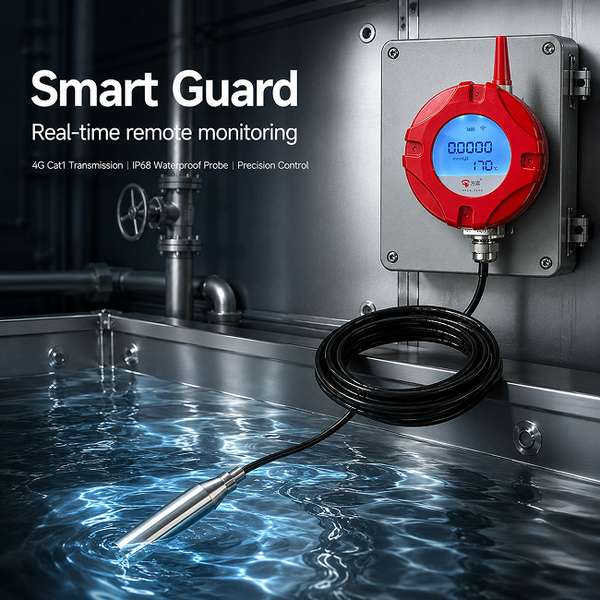
Low Power Level Monitor — Professional Wireless Level Measurement by Wanlin Fire Control
Product Category: Wireless Liquid Level Gauge / Transmitter
Measurement Technology: Configurable — ultrasonic, radar, submersible, or float
Measurement Range: 0-1m to 0-200m (technology and model dependent)
Accuracy: ±0.1% FS to ±0.5% FS (model dependent)
Output Signal: 4-20mA + RS485 Modbus RTU (standard), HART optional
Wireless Connectivity: 4G LTE Cat.1 / NB-IoT / LoRaWAN / WiFi (configurable)
Power Supply: DC 9-36V or built-in lithium battery 19-38Ah + optional solar panel
Display: Backlit LCD showing level, percentage, temperature, signal strength
Protection Rating: IP67 (standard), IP68 (submersible models)
Housing Material: Aluminum alloy with epoxy coating or 316L SS
Operating Temperature: -40°C to +85°C (electronics), sensor per spec
Data Logging: Built-in memory for offline data storage with auto-sync on reconnection
Alarm: Configurable high/high-high/low/low-low with multi-channel notification
Certifications: CE, FCC, RoHS, IP67/IP68; Optional: ATEX, SIL2
Mounting: Thread / flange / bracket / hanging — per model
Export Packaging: Industrial box with complete accessories, quantity per model spec
We understand that choosing the right Low Power Level Monitor supplier is a critical business decision with direct impact on your customers' operations and safety. Here is why Wanlin Fire Control stands out as the preferred China manufacturing partner for level instrumentation:
✓ Technology Breadth: We manufacture ultrasonic, radar (79GHz FMCW), submersible hydrostatic, magnetostrictive, magnetic flap, and float-based level instruments — a complete portfolio enabling you to serve every customer application from a single supplier, simplifying procurement, logistics, and support.
✓ Multi-Protocol Wireless: Our instruments support 4G LTE Cat.1, NB-IoT, LoRaWAN, WiFi, and Zigbee — we help you select and configure the optimal protocol for your region's network coverage, data requirements, and cost constraints.
✓ Global Certification Portfolio: CE, FCC, ATEX/IECEx, RoHS, REACH, WEEE, SIL2/SIL3, IP68, and regional certifications including UKCA, GOST/EAC — ensuring compliance for markets across Europe, North America, Middle East, Asia-Pacific, and CIS.
✓ Complete Export Support: Full documentation packages (certificates, test reports, manuals, CAD drawings), multilingual packaging and labeling, reliable freight partnerships, and dedicated English-speaking export coordination — we handle the complexity so you can focus on sales.
✓ Flexible OEM/ODM: Custom ranges, output signals, branding, packaging, and even sensor housing materials — our engineering team adapts products to your specific market requirements with typical 20-30 day turnaround from specification to samples.
✓ Distributor Partnership Model: We invest in our distributors' success with comprehensive technical training, co-branded marketing materials, territory protection options, lead referrals, and responsive support — our growth is built on making our partners successful in their local markets.
What makes the Low Power Level Monitor from Wanlin Fire Control the preferred choice for level measurement professionals and distributors worldwide:
1. Vertical Integration: We design and manufacture our own sensor elements, communication modules, enclosures, and cloud platform — ensuring end-to-end quality control, rapid customization capability, and cost efficiency unmatched by companies that assemble third-party components.
2. Field-Proven Reliability: Over 50,000 units deployed across 60+ countries in applications ranging from Saudi Arabian oil terminals to Indonesian water utilities to Australian mine sites — confirmed <99.7% measurement uptime in real-world conditions.
3. Intelligent Cloud Platform: Our Wanlin Cloud platform provides real-time visualization with GIS mapping, multi-level configurable alarms with SMS/email/app notification, automated reporting, historical trend analysis, and RESTful API for SCADA integration — all included with every wireless sensor purchase.
4. Power Flexibility: Multiple power configurations — built-in long-life lithium battery (3-5 years), solar panel + rechargeable battery (unlimited operation), and DC wired power — ensure reliable operation in any installation scenario from remote boreholes to on-site process tanks.
5. Application Engineering Support: Unlike many manufacturers who simply sell products, we provide application engineering consultation — sensor selection guidance, installation recommendations, calibration support, and system architecture design — ensuring successful deployments and satisfied end customers.
6. Competitive Total Cost of Ownership: Factory-direct pricing delivers 40-55% distributor margin potential, while our product reliability, long battery life, and low maintenance requirements minimize total cost of ownership for end users — creating value that drives repeat orders and customer loyalty.
Selection depends on several factors: Choose ULTRASONIC for: clean liquids, open tanks, calm surfaces, budgets under $300/unit, ranges 0-20m. Avoid with foam, vapor, dust, or turbulence. Choose RADAR (79GHz) for: all liquids including corrosive, high temperature/pressure, agitated surfaces, foam/vapor environments, ranges 0-30m, where non-contact is essential. Best for chemical/petrochemical applications. Choose SUBMERSIBLE/HYDROSTATIC for: deep wells/boreholes (>20m), pressurized tanks, where the sensor must be below the liquid surface, lowest cost per meter of range, consistent-density media. Not suitable for solids, sludge, or media that coat/foul the sensor. Our application engineers provide free selection guidance — just share your tank dimensions, media properties, temperature, and any special requirements.
For off-grid installations, we offer several power solutions: Solar-powered configuration — 20W/40W solar panel + MPPT charge controller + 38Ah lithium battery, providing 24/7 operation with hourly data upload (10+ days autonomy without sun). This is our most popular configuration for remote water wells, reservoir monitoring, and agricultural applications. Ultra-low-power battery-only — 19Ah/38Ah D-cell lithium battery pack, 3-5 years operation with 1-hour upload interval. Suitable for sewer manholes, underground vaults, and temporary monitoring. External battery + 4G DTU — supports any 12V/24V battery system. All configurations include comprehensive power management: battery voltage monitoring, solar charge tracking, low-battery multi-stage alerts, and configurable sleep/wake cycles to extend battery life.
Yes, we support multiple integration paths: Direct I/O — 4-20mA analog output + relay outputs for direct PLC/RTU connection without any wireless infrastructure; Modbus RTU over RS485 — digital communication with standard industrial controllers; Modbus TCP over 4G/WiFi — IP-based integration with modern SCADA systems; MQTT/HTTP — native IoT protocol for cloud-based platforms and custom applications; OPC UA (available on premium models) — for seamless integration with Siemens, Rockwell, Schneider, and other major DCS platforms; HART protocol — for HART-enabled systems, with wireless HART adapter options. We provide detailed register maps, Modbus point lists, and integration guides for all major SCADA platforms.
Data security is implemented at multiple layers: Device-to-cloud — TLS 1.3 encrypted MQTT/HTTPS communication, device authentication via unique certificate + token, data integrity verification with HMAC; Cloud platform — AES-256 encrypted data storage, SOC 2 Type II certified infrastructure, GDPR-compliant data handling, role-based access control (viewer/operator/administrator), full audit logging of all user actions; On-premise option — private server deployment available for enterprises requiring complete data sovereignty, air-gapped operation with local data storage and sync; Network security — VPN tunneling (IPsec/L2TP) support for integration with corporate networks, firewall-friendly protocols, no open inbound ports required on customer network.
Several factors differentiate us: 1) Vertical integration — we design and manufacture our own sensor elements, communication modules, and cloud platform, ensuring end-to-end quality control; 2) Application engineering — we don't just sell products, we solve problems. Our engineers help with sensor selection, installation design, and system architecture; 3) Global certification depth — we maintain active CE, FCC, ATEX, RoHS, REACH, and regional certifications, continuously updated; 4) Export infrastructure — dedicated export documentation team, multi-language packaging and manuals, logistics partnerships with major freight forwarders; 5) Long-term commitment — we've been in business for over a decade, with 5+ year spare parts availability and product continuity guarantees; 6) Technology investment — our R&D team continuously improves products based on field feedback and emerging standards.
Yes, for oil-water interface measurement, we offer: Guided wave radar (GWR) — detects the interface between two immiscible liquids based on dielectric constant difference, ideal for oil/water separation tanks, 0.1-20m range; Magnetostrictive with dual floats — one float calibrated for oil density, one for water density, providing both total level and interface level simultaneously; Capacitance-based interface probes — for applications where the dielectric difference between liquids is significant; Ultrasonic interface detection — for sludge blanket level in water treatment clarifiers and thickeners. We recommend discussing your specific media properties (dielectric constants, densities, separation layer thickness) with our application engineers for the optimal technology selection.
Data upload frequency is fully configurable from 1 minute to 24 hours, with remote configuration via our cloud platform or mobile app — no need to visit the site. Common configurations: 5-15 minutes for critical process monitoring, 30-60 minutes for utility water level monitoring, 2-6 hours for groundwater monitoring. The device supports event-triggered uploads — immediate data transmission when level exceeds threshold, changes rapidly (configurable delta), or when alarm conditions occur. For ultra-low-power applications, the device enters deep sleep between uploads, consuming <10μA. Configuration changes take effect on the next scheduled wake cycle.
We employ multiple false alarm prevention strategies: Software filtering — moving average, median filter, and Kalman filter algorithms smooth out wave-induced fluctuations; Configurable damping — user-adjustable response time (0-60 seconds) to filter transient level changes; Multi-sample verification — alarm only triggers after N consecutive readings exceed threshold (configurable N=1-10); Rate-of-change monitoring — distinguishes normal filling/draining from sudden anomalies; Sensor health diagnostics — continuous self-check detects sensor fouling, signal loss, or degraded performance and alerts before false readings occur; Dual-sensor redundancy (for critical applications) — two independent sensors with cross-validation; False echo suppression (ultrasonic/radar) — learns and ignores fixed obstacles (ladders, agitators, heating coils) via false echo mapping during commissioning.
Our Low Power Level Monitor and wireless level measurement solutions have earned the trust of partners and end users across diverse industries and geographies:
✓ Kenyan Community Water Project: A Kenyan NGO managing 200+ community water points across rural counties deployed Wanlin LoRa level sensors with solar power for remote monitoring of borehole water levels and storage tank levels. The LoRa network provided coverage across the dispersed sites without cellular subscription costs. Real-time data enabled the operations team to dispatch maintenance crews proactively when water levels indicated pump or system issues — before communities reported outages. The system reduced water service interruptions by 65% and was featured in a UN Water case study on technology-enabled rural water management.
✓ German Chemical Distributor: A German chemical distribution company launched their private-label level measurement product line powered by Wanlin OEM manufacturing. Starting with a 100-unit trial of customized ultrasonic level sensors with German-language interfaces and TüV-ready documentation, they expanded to 500+ units monthly within 12 months. Their product line now includes 8 SKUs across ultrasonic, radar, and submersible technologies. Wanlin's CE/ATEX certification package and REACH/RoHS compliance documentation were critical enablers for the EU market entry.
✓ Brazilian Mining Operation: A major Brazilian iron ore mining operation deployed 350 Wanlin ultrasonic level sensors across their tailings dams, process water ponds, and chemical reagent tanks. The solar-powered 4G configuration eliminated the need for cabling across the vast site. The IP68-rated sensors with anti-corrosion PVDF housings withstood the aggressive chemical environment. Remote monitoring enabled 24/7 dam safety compliance with Brazilian mining regulations (ANM), and the early-warning flood detection system prevented a potential tailings overflow incident during an extreme rainfall event.
Investing in high-quality Low Power Level Monitor from Wanlin Fire Control is a strategic decision that delivers reliable measurements, protects operational safety, and builds a sustainable business in the rapidly growing wireless level instrumentation market. Our certified products combine advanced sensor technology with competitive pricing and comprehensive distributor support, making us the preferred China manufacturing partner for level measurement professionals worldwide.
Whether you are an industrial instrumentation distributor expanding your product line, a system integrator seeking reliable OEM sensor supply, a water utility equipment supplier, or an e-commerce seller building a private-label measurement brand — Wanlin Fire Control has the technology breadth, certification depth, and export expertise to support your success.
Contact us today to discuss your Low Power Level Monitor requirements, request evaluation samples, and receive a competitive quotation. Let us help you bring reliable, certified wireless level measurement solutions to your market.